

Common early symptoms include blurry or cloudy vision, glare or halos around lights, difficulty seeing at night, and colors appearing faded or yellowed.
Cataracts
Condition
Cataracts
A cataract is a common progressive visual condition that impacts your vision. CODET’s advanced technology offers effective solutions to remove cloudiness and restore clarity.
An Overview: Cataracts
At a Glance:
- Cataracts develop, naturally, with age
- Cataracts affect the elasticity and transparency of the crystalline lens
- The loss of elasticity is called presbyopia
- Cataracts should be removed when they prevent clear vision
A cataract is a change in density and/or transparency of the eye’s crystalline lens. The crystalline is the lens located behind the iris, and its main function is to provide the visual system of optical accommodation, much like the zoom function in a camera.
With age and by the natural oxidative process of the human body, the crystalline lens tends to lose elasticity and transparency over time. This loss of elasticity is known as presbyopia, which is a progressive visual condition that starts around the age of 40.
Eventually, not only does the crystalline lens lose its accommodative ability, but it also loses its transparency: This is when it becomes a cataract. At a certain point, cataracts will prevent clear vision and will have to be removed.
Cataract Surgery and Treatment
More than 25 million cataract surgeries are performed each year, making it the most common surgical procedure in the world:
- High-tech, quick, painless removal procedure
- Replacement lens implanted
- Various intraocular lens (IOL) options
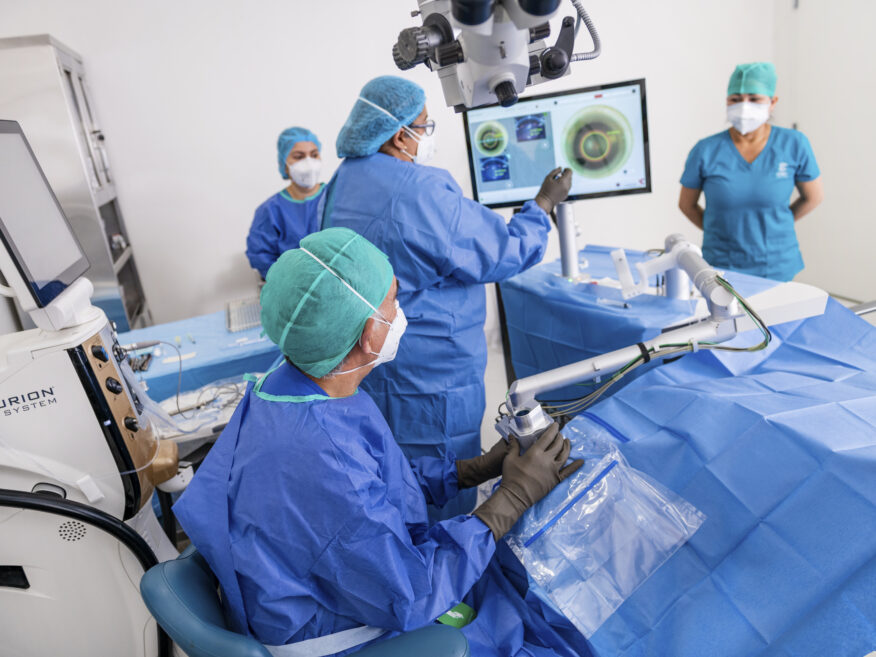
Today, cataracts are extracted through a high-tech, quick, painless, and effective surgical procedure. After administrating topical anesthesia (eye numbing drops) in place, we use ultrasonic technology to create a small incision (2-3 mm). Once the cataract is removed, an intraocular lens (IOL) is implanted to replace the crystalline lens. The CODET cataract team is one of the only ophthalmic centers in Mexico to use the cutting-edge Centurion Vision System from Alcon; this groundbreaking technology provides optimal results.
Laser technology has significantly increased the precision of many key steps of cataract surgery, which traditionally is performed with a hand-held blade. With a computer-aided laser and advanced 3D imaging, laser cataract removal is quicker, uses fewer instruments, requires less energy, and results in less strain on the eye.
CODET will determine the best cataract removal approach for you and will customize the procedure to meet your unique vision needs.
About Intraocular Lenses (IOLs)
Our goal with modern-day cataract surgery is to leave the eye without nearsightedness, farsightedness and/or astigmatism so that the patient’s distance vision is the best possible without the need for glasses.
A new generation of premium intraocular lenses is here: This modern standard of IOLs simultaneously addresses near vision and distance vision, similar to progressive spectacle lenses. Among these options, CODET offers a revolutionary, extremely customizable IOL called Light Adjustable Lens (LAL).
We’ll work with you individually to evaluate the best possible intraocular solution for your unique case. Options might include:
- Monofocal
- Multifocal
- Trifocal
- Toric (for astigmatism)
- Light Adjustable Lens
- Extended Depth of Focus
Why CODET for Cataract Care?
Our founder, Dr. Arturo Chayet, has performed more than 15,000 cataract surgeries over his 30+ years in the industry. He’s a pioneer in not only surgery but also clinical research.
In 1999, Dr. Chayet conducted the first clinical trial on accommodating IOLs for Ionics (now Bausch & Lomb), and he was instrumental in developing Crystalens, the first FDA-approved accommodating IOL. CODET, along with RxSight, conducted 600+ clinical trials of light adjustable lenses before the procedure was available to the public, making our refractive surgeon team the most experienced with LAL in the world.
Astigmatism Correction
- At CODET Vision Institute, we correct astigmatism in cataract and IOL surgery, at no extra cost
- Together, our doctors and patent pending technology can achieve full astigmatic correction in every case
- We’ve developed proprietary technology that allows our doctors to better track, understand, and optimize cataract and IOL surgery results